Cash HuntUK focused18+ only

Cash Hunt: The 108-Target Bonus Round

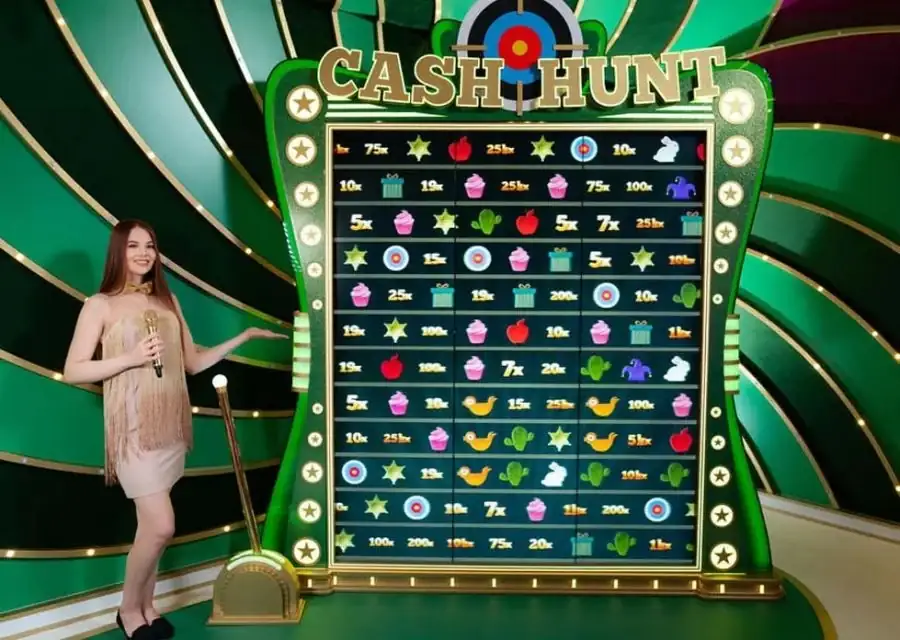
Cash Hunt is one of Crazy Time's four bonus rounds, triggering on roughly 3.7% of spins (2 of the 54 wheel segments). When it triggers, players are presented with a grid of 108 multiplier targets hidden behind cannon symbols; each player picks one target, and the multiplier hidden beneath determines the payout. Cash Hunt has the highest verified theoretical ceiling in Crazy Time at 25,000×, set on 11 December 2022. Its per-bonus RTP is 95.27%, slightly below the headline game RTP of 96.08%. This page covers the mechanic in depth, the math behind the multiplier distribution, the 25,000× tail context, and the responsible gambling framing that applies to chasing the headline outcome.

Practise Cash Hunt mechanics in the demo: free, no real-money risk.

Play Crazy Time: operator checklist before real-money play. 18+. Play responsibly. BeGambleAware.

Updated
25 May 2026
Sections
16
Focus
No prediction claims
Crazy Time Cash Hunt bonus game screen
Cash Hunt mechanics are illustrated with a local feature-round screenshot.

Section 01

At a Glance

Cash Hunt, at a glance:

  • Mechanic: 108-target grid, player pick from shuffled distribution
  • Trigger rate: ~3.70% per spin (2 of 54 wheel segments, roughly 1-in-27 spins)
  • Per-bonus RTP: 95.27% (below the headline 96.08% game RTP)
  • Per-bonus house edge: 4.73%
  • Theoretical ceiling: 25,000×
  • Verified all-time record: 25,000× on 11 December 2022
  • Typical outcome range: 5× to 100× (vast majority of outcomes)
  • Rare upper-tail outcomes: 1,000×+ occur but are uncommon
  • Variance: medium-high (wide outcome distribution skewed toward smaller multipliers)
  • Per-bonus duration: ~60-75 seconds end-to-end on the live broadcast
  • Top Slot compounding applies: when the bet reel aligns with Cash Hunt segment, the Top Slot multiplier compounds the Cash Hunt outcome
  • All four certified by the UKGC's required audit chain (Gaming Laboratories International, eCOGRA, iTech Labs, BMM Testlabs)
  • No skill on pick: selection is random under the shuffled distribution; there's no "best target" strategy

Here's how Cash Hunt fits with the rest of Crazy Time: it's a moderate-frequency, high-ceiling bonus that sits between the most frequent (Coin Flip) and the rarest (Crazy Time bonus). The other three bonus rounds (Coin Flip, Pachinko, Crazy Time bonus) make up the remaining 7 of 9 bonus segments on the wheel.

Crazy Time Cash Hunt bonus screen with multiplier targets
Cash Hunt uses a target grid, hidden multipliers, and high variance around rare large outcomes.

Game mechanic

What Cash Hunt Is

Cash Hunt is one of the four bonus rounds in Evolution Gaming's Crazy Time live casino game show, broadcast 24/7 from Evolution's studio in Riga, Latvia. The other three bonuses are Coin Flip, Pachinko, and the Crazy Time bonus; collectively they occupy 9 of the 54 wheel segments, so some bonus triggers on about 16.7% of spins.

Cash Hunt's position in the game

  • Trigger frequency: moderate (more frequent than the Crazy Time bonus's ~1.85%, less frequent than Coin Flip's ~7.4%)
  • Theoretical ceiling: highest verified upper bound at 25,000× (above the verified outcomes from Coin Flip, Pachinko, and the Crazy Time bonus to date)
  • Visual format: distinctive 108-target grid that appears on the broadcast when the bonus triggers
  • Player input: each player selects one target from the shuffled grid
  • Payout: the multiplier hidden beneath the selected target applies to the player's Cash Hunt bet

Why Cash Hunt has the highest ceiling

The four bonus rounds use different mathematical designs. Cash Hunt uses a single-pick mechanic against a weighted multiplier distribution that includes the 25,000× value. The other bonuses use different mechanics: Coin Flip's tighter range, Pachinko's DOUBLE chain compounding, the Crazy Time bonus's DOUBLE/TRIPLE chain compounding. Cash Hunt's design supports the single highest theoretical multiplier value structurally embedded in the grid.

How to recognise Cash Hunt on the broadcast

When the main wheel's flapper settles on a Cash Hunt segment, the stream switches from the main wheel view to the Cash Hunt grid display. 108 cannon-symbol targets appear, arranged in rows. They shuffle visibly for a few seconds (rearranging the hidden multipliers behind them), then the targets settle and the presenter calls "Pick your target". The bonus runs for about 60-75 seconds end-to-end.

For the position of Cash Hunt within the broader bonus comparison framework, see the bonus rounds hub.

Crazy Time Cash Hunt bonus screen with multiplier targets
Cash Hunt uses a target grid, hidden multipliers, and high variance around rare large outcomes.

Game mechanic

How Cash Hunt Triggers

Cash Hunt occupies 2 of the 54 wheel segments. Per spin, the trigger probability is:

2 / 54 = 3.70% (roughly 1-in-27 spins)

What this means in practice

Each spin is independent under the RNG. The 3.70% probability applies to every spin equally; the wheel has no memory.

  • In a 100-spin session, you'd expect roughly 3-4 Cash Hunt triggers on average
  • Individual sessions vary widely: 1 trigger in 100 spins is possible; 8 triggers in 100 spins is also possible
  • Across a 1,000-spin sample, the count converges toward 37 triggers (1,000 × 0.037)
  • Across 10,000 spins, the count converges toward 370 triggers

The variance in short sessions is mathematically normal. A drought of 50+ spins without a Cash Hunt isn't unusual; a cluster of 3 within 20 spins isn't unusual. Both patterns are random outcomes of independent per-spin probability.

What this doesn't mean

  • Cash Hunt is never "due". Previous spins don't change the next spin's probability.
  • Recent triggers don't make future triggers less likely. The probability resets every spin.
  • Watching the broadcast doesn't help you predict triggers. Triggers are determined by the live wheel; there's no pattern in the timing.
  • Bet selection doesn't change the trigger rate. The wheel triggers Cash Hunt at the same 3.70% rate regardless of whether you bet on Cash Hunt or not. Bet selection only determines whether you win when the bonus triggers, not whether the bonus triggers.

For deeper coverage of the independence of spins and why "due" thinking is a fallacy, see the strategy page's hot and cold segment myths.

Crazy Time Cash Hunt bonus screen with multiplier targets
Cash Hunt uses a target grid, hidden multipliers, and high variance around rare large outcomes.

Section 04

The 108-Target Grid

The Cash Hunt grid is the visual centrepiece of the bonus. It's worth understanding what's actually on the grid and how the player interacts with it.

What you see when the bonus triggers

  • 108 cannon symbols arranged in a grid pattern across the screen
  • Each cannon hides a multiplier value that will pay out if selected
  • The cannons shuffle visibly for a few seconds (the hidden multipliers are reassigned to different grid positions during the shuffle)
  • Once shuffling stops, the presenter calls "Pick your target"
  • A countdown timer begins (typically 5-10 seconds for the pick window)
  • Each player clicks or taps one target to lock in their selection
  • After the pick window closes, each player's target reveals the multiplier hidden beneath it
  • The multiplier applies to that player's Cash Hunt bet

Why 108 specifically

108 is a structural design choice by Evolution Gaming. The number balances:

  • Enough targets to feel meaningfully randomised (a smaller grid would feel limited)
  • Few enough to be visually scannable in the bonus time window (108 in rows fits the broadcast frame)
  • Enough distribution slots to support a wide multiplier range from low (single digits) to the 25,000× ceiling
  • Visual variety: the cannon symbols create the cohesive visual format

The 108 number itself doesn't have mathematical significance for outcome probabilities; it's the framework within which the weighted multiplier distribution operates.

Player perspective during the pick

Players see the shuffled grid for a few seconds. There's no information distinguishing high-multiplier targets from low-multiplier targets; all 108 cannons look identical. The shuffle ensures that the multiplier-to-position mapping is randomised before each bonus round; the player's pick is, effectively, selection from a randomised set.

What happens after the pick

  • Each player's target reveals simultaneously after the pick window closes
  • The presenter calls out notable wins (high multipliers picked by players)
  • Each player's individual result displays in their operator interface
  • Multipliers are paid out automatically based on the Cash Hunt bet size

The full reveal-and-payout sequence typically takes 30-40 seconds within the 60-75 second total bonus duration.

Crazy Time Cash Hunt bonus screen with multiplier targets
Cash Hunt uses a target grid, hidden multipliers, and high variance around rare large outcomes.

Section 05

Multiplier Distribution on the Grid

The 108 targets each hide a multiplier value. The distribution of values is weighted: not every multiplier value appears the same number of times. Understanding the weighting is core to understanding Cash Hunt's variance.

General distribution shape

While Evolution doesn't publish the exact distribution publicly, the shape can be inferred from observed outcomes and the published per-bonus RTP of 95.27%:

  • Most targets hide low multipliers: single digits to mid double-digits (the bulk of the distribution)
  • Fewer targets hide mid-range multipliers: 50× to 200× range
  • Few targets hide higher multipliers: 300× to 1,000× range
  • Very few targets hide upper-tail multipliers: 1,000× to 10,000× range
  • Extreme upper-tail: the 25,000× value is structurally embedded but extremely rare on the grid

Why the weighting matters

The distribution shape is what produces Cash Hunt's variance profile:

  • The vast majority of Cash Hunt outcomes (across many bonuses) settle in the lower-to-mid multiplier range. A player whose Cash Hunt outcomes consistently land in the 5×-50× range is experiencing typical variance, not bad luck.
  • Upper-tail outcomes (1,000×+) are statistically rare. A player who hits a 5,000× outcome in their first 10 Cash Hunt rounds is experiencing exceptionally fortunate variance; the modal outcome is much lower.
  • The 25,000× ceiling exists structurally but the probability of hitting it on any single pick is extremely small. Across all Cash Hunt rounds globally since launch (4+ years of 24/7 broadcast), the 25,000× has been verified once.

The weighted average is the RTP

The published per-bonus RTP of 95.27% is the weighted average payout across the full distribution of possible outcomes, multiplied by trigger probability and normalised to bet size. It captures the long-term expected return per Cash Hunt bonus across many sessions. The number is below the headline 96.08% game RTP because the bonus betting collectively has slightly higher house edge than the number betting.

Distribution does shift visually

Some Cash Hunt rounds have visibly higher upper-tail multipliers on display during the shuffle (when high values can be glimpsed briefly before settling). Other rounds show predominantly lower multipliers. This is part of the per-round randomisation; players sometimes try to "memorise" high-value positions during the shuffle, but the final reshuffle obscures positions before the pick window opens.

Crazy Time Cash Hunt bonus screen with multiplier targets
Cash Hunt uses a target grid, hidden multipliers, and high variance around rare large outcomes.

Section 06

The Pick Mechanic and Player Input

Each player selects one target from the shuffled grid. Worth being explicit about what player input actually contributes.

What the pick does

  • Locks in your selection of one specific cannon target
  • Reveals the multiplier hidden beneath that target after the pick window closes
  • Determines your Cash Hunt payout based on the revealed multiplier × your Cash Hunt bet size

What the pick doesn't do

  • It doesn't influence the multiplier distribution. The multiplier hiding beneath your target was assigned during the shuffle, before you picked.
  • It doesn't matter which specific target you pick. All 108 targets have the same probability of hiding any specific multiplier value (because the distribution is randomised across grid positions before each pick window).
  • It isn't a "skill" decision. There's no information distinguishing high-multiplier targets from low-multiplier targets at the moment of pick.
  • It can't be "optimised" through pattern recognition, target memorisation, or any other approach. The shuffle randomises positions; visible patterns during shuffle don't persist through the final reshuffle.

Why some players believe pick choice matters

A common cognitive bias: players who hit high multipliers attribute the outcome to their pick choice ("I picked the right target"), and players who hit low multipliers attribute it to bad luck ("I picked the wrong one"). The math is the opposite of what intuition suggests: the multiplier was already assigned to the position before the pick; the pick was effectively random selection from a shuffled distribution.

This is the same cognitive bias that affects Coin Flip ("I should have bet on red"), Pachinko ("I should have predicted the bounce"), and the Crazy Time bonus ("I should have picked a different flapper"). All four bonuses have player input that feels meaningful in the moment but doesn't change long-term outcomes.

Pick selection in practice

If pick choice doesn't matter, why does the bonus require a pick at all? The pick mechanic serves engagement purposes:

  • It creates moment-of-decision involvement for each player
  • It feels like active participation rather than passive observation
  • It differentiates the bonus from a purely random "your multiplier is X" reveal

The engagement value is real; the strategic value isn't. Pick whatever target appeals visually; the outcome distribution is identical regardless of which of 108 targets you choose.

Crazy Time Cash Hunt bonus screen with multiplier targets
Cash Hunt uses a target grid, hidden multipliers, and high variance around rare large outcomes.

Data check

Cash Hunt RTP and House Edge

The published per-bonus RTP for Cash Hunt is 95.27%, with a corresponding house edge of 4.73%.

How this compares to the headline game RTP

How this compares to the headline game RTP table
MetricGame (headline)Cash Hunt (per-bonus)
RTP96.08%95.27%
House edge3.92%4.73%

Cash Hunt's per-bonus RTP sits 0.81 percentage points below the headline. The difference is small but meaningful for sustained bonus-only betting patterns.

Why per-bonus RTPs differ

The headline 96.08% RTP is the weighted average across all eight bet types (1, 2, 5, 10 wedge bets + 4 bonus bets). The per-bonus RTPs reflect the long-term return when the relevant bonus triggers, weighted across the full multiplier distribution. The four bonus per-bonus RTPs sit at 94.33% (Pachinko), 94.41% (Crazy Time bonus), 95.27% (Cash Hunt), and 95.70% (Coin Flip).

The number bets (1, 2, 5, 10 wedges) all sit close to the 96.08% headline RTP; the bonus bets collectively pull slightly below it, which is why bonus-only betting has a slightly higher house edge than mixed betting.

Expected loss math

For a player betting £1 on Cash Hunt each spin:

  • Per-bonus expected outcome: ~£25-£50 expected payout per trigger (weighted average across distribution × bet size)
  • Per-spin expected return: 0.037 (trigger probability) × £30 average payout = approximately £1.11 per £1 staked
  • Long-term expected loss: roughly £0.05 per £1 staked (matches the ~4.73% house edge)

This is a long-term expected value across very large sample sizes, not a per-bonus prediction. Individual Cash Hunt triggers might pay £3 or £5,000; the average emerges only across many triggers.

Practical implications

A player betting £1 on Cash Hunt across 1,000 spins would:

  • Trigger Cash Hunt approximately 37 times (1,000 × 0.037)
  • Receive total payouts averaging roughly £950 (1,000 × £0.95 expected return per £1 staked)
  • Experience long-term expected loss of approximately £50 (5% of £1,000 staked, slightly above the 4.73% house edge due to variance)

Short-term outcomes vary widely. The variance in any single session can be substantially different from the long-term average.

For the full RTP math including sample size convergence and the math behind expected loss, see the RTP page.

Crazy Time Cash Hunt bonus screen with multiplier targets
Cash Hunt uses a target grid, hidden multipliers, and high variance around rare large outcomes.

Game mechanic

Variance and Expected Cash Hunt Outcomes

The wide multiplier distribution gives Cash Hunt a medium-high variance profile. Worth knowing what to actually expect from typical bonuses.

Distribution of single-bonus outcomes

Approximate outcome distribution per Cash Hunt trigger (based on observable broadcast patterns + 95.27% per-bonus RTP):

Distribution of single-bonus outcomes table
Outcome rangeApproximate frequency
5× to 25×Most common (a substantial share of all bonuses)
25× to 100×Common (next-most-frequent range)
100× to 500×Less common (interesting outcomes)
500× to 2,000×Notable (memorable session outcomes)
2,000× to 10,000×Rare (significant variance events)
10,000×+Very rare (record-territory outcomes)
25,000×Extreme upper-tail (verified once, December 2022)

These are rough proportions rather than exact published figures; Evolution doesn't publish per-bonus outcome distribution data. The shape is inferable from observed broadcast patterns and the published RTP.

What a typical session looks like

A player who hits 5 Cash Hunt bonuses in a session might experience:

  • 3 outcomes in the 5×-25× range (typical)
  • 1 outcome in the 25×-100× range (good)
  • 1 outcome in the 100×-500× range (memorable)

This is mathematically typical. Across 5 Cash Hunt rounds, no upper-tail outcome is expected; the modal session is a mix of typical results.

A different player hitting 5 Cash Hunt bonuses might experience all 5 in the 5×-25× range (a "cold" session of typical outcomes) or, very rarely, one 1,000×+ outcome alongside several lower ones. Both are within normal variance.

Why session experience varies wildly

Cash Hunt's variance profile is the reason. The wide multiplier distribution means:

  • Most sessions feel modest: typical outcomes dominate
  • Some sessions feel substantial: when an upper-tail outcome lands
  • Very few sessions feel exceptional: when 5,000×+ outcomes land
  • The 25,000× exists but has been verified once in 4+ years of 24/7 broadcast

What this means for bet sizing

If you're betting Cash Hunt with bankroll calibrated to typical outcomes, you'll experience long droughts between substantial wins. If you're betting Cash Hunt with bankroll calibrated to chasing upper-tail outcomes, you'll likely deplete bankroll before any upper-tail outcome arrives. Cash Hunt rewards bankroll discipline; it punishes bankroll calibration based on big-win expectations.

For bankroll framework, see strategy: bankroll management.

Crazy Time Cash Hunt bonus screen with multiplier targets
Cash Hunt uses a target grid, hidden multipliers, and high variance around rare large outcomes.

Game mechanic

Top Slot Compounding with Cash Hunt

The Top Slot is the bet-and-multiplier reel pair above the main wheel. Each spin, the bet reel and multiplier reel generate independent random outputs. When the Top Slot bet reel lands on Cash Hunt and the main wheel lands on Cash Hunt, the Top Slot multiplier compounds the Cash Hunt outcome.

How the compounding works

If you bet £1 on Cash Hunt and:

  • The wheel triggers Cash Hunt
  • Your selected target reveals a 100× multiplier
  • The Top Slot bet reel landed on Cash Hunt for this spin
  • The Top Slot multiplier reel showed 10×

Then your payout becomes: £1 × 100 × 10 = £1,000 instead of £100 (a 10× compounding bonus).

Top Slot + Cash Hunt alignment probability

The Top Slot bet reel has 8 segments matching the 8 main wheel bet types. The probability of the bet reel landing on Cash Hunt specifically is approximately 1-in-8 (12.5%) per spin. The probability of the main wheel ALSO landing on Cash Hunt is 3.70% per spin.

Combined Top Slot + wheel alignment on Cash Hunt: 0.125 × 0.037 = approximately 1-in-216 spins (0.46%).

Out of this alignment, the Top Slot multiplier itself varies (typically 2× to 50×), with smaller multipliers more frequent than larger ones.

The compounding effect on records

Most of Crazy Time's headline big-win records involve Top Slot + bonus alignment in addition to the underlying bonus outcome. The 25,000× Cash Hunt record from December 2022 was the underlying Cash Hunt multiplier; whether it included Top Slot alignment is part of the record context (see the 25,000× Cash Hunt record on the biggest wins page for full context).

Top Slot is already in the published RTP

The published 96.08% headline RTP and the 95.27% Cash Hunt per-bonus RTP already include Top Slot's expected contribution. Top Slot isn't an extra layer of expected value; it's part of the calculated weighted average that produces the published figures.

For the full Top Slot math including how it affects per-bet RTPs across the wheel, see Top Slot and RTP.

Crazy Time Cash Hunt bonus screen with multiplier targets
Cash Hunt uses a target grid, hidden multipliers, and high variance around rare large outcomes.

Section 10

The 25,000× Tail Distribution

The 25,000× ceiling is Cash Hunt's most-cited fact. Worth understanding what the ceiling actually means probabilistically.

What 25,000× means structurally

The 25,000× multiplier is structurally embedded in the Cash Hunt grid distribution: one (or very few) of the 108 targets hides this value, when the per-round distribution includes it. Not every Cash Hunt round has a 25,000× value on the grid; the per-round weighting determines whether the upper-tail values are present in any given round.

The verified all-time record

The only verified Cash Hunt outcome at the 25,000× ceiling in Crazy Time's history (as of latest verification): 11 December 2022.

That single outcome:

  • Occurred during a Cash Hunt bonus round on the live broadcast
  • Was witnessed by all viewers and players on the live feed at that moment
  • Was documented across operator-side feeds and third-party gambling content
  • Has stood as the verified all-time record since

In approximately 4+ years of continuous 24/7 broadcast (since Crazy Time's launch on 1 July 2020), with Cash Hunt triggering on roughly 3.7% of spins, the 25,000× has been verified once. This gives a rough sense of the tail rarity.

For the full record context including how the verification was established and what's been verified at the per-bonus level for the other three bonuses, see Crazy Time biggest wins and top multipliers.

Tail probability framing

If we estimate roughly how often the 25,000× tail might appear (with substantial uncertainty given lack of public per-target distribution data):

  • Cash Hunt triggers: ~37,000-40,000+ per year globally on the live broadcast (at 3.7% of approximately 1,000,000+ spins per year)
  • Verified 25,000× outcomes: 1 in 4+ years

This suggests the 25,000× tail outcome occurs at approximately 1-in-150,000+ Cash Hunt triggers (or 1-in-4,000,000+ spins, given the 3.7% Cash Hunt trigger rate). These are rough estimates; the actual tail probability could be higher (multiple outcomes have happened, just unreported) or lower (the verified record is a true exceptional event).

Why this matters for player expectations

The 25,000× is part of Crazy Time's marketing narrative and a frequent subject of big-win content. Worth being clear about the math:

  • The 25,000× exists as a structural ceiling
  • It's been verified once in the game's history
  • Probability of hitting it on any single Cash Hunt trigger is extremely small
  • Probability of hitting it on any single spin is far smaller (3.7% × very small)
  • Treating 25,000× outcomes as a session target isn't supported by the math

For the harm-reduction context around chasing record outcomes, see responsible gambling: survivorship bias and big-win content and the section below.

Crazy Time Cash Hunt bonus screen with multiplier targets
Cash Hunt uses a target grid, hidden multipliers, and high variance around rare large outcomes.

Game mechanic

Cash Hunt vs Other Bonus Rounds

Worth comparing Cash Hunt to the other three bonuses to position it accurately.

Cash Hunt vs Other Bonus Rounds table
BonusTrigger rateRTPVarianceCeilingKey mechanic
Coin Flip~7.41%95.70%LowestModerateTwo-coin flip
Cash Hunt~3.70%95.27%Medium-high25,000×108-target pick
Pachinko~3.70%94.33%HighSubstantialPuck drop + DOUBLE chains
Crazy Time bonus~1.85%94.41%HighestVery largeFlapper pick + DOUBLE/TRIPLE chains

How Cash Hunt differs from each

vs Coin Flip:

  • Cash Hunt triggers about half as often (3.7% vs 7.4%)
  • Coin Flip has slightly higher RTP (95.70% vs 95.27%)
  • Cash Hunt has much higher ceiling (25,000× vs Coin Flip's modest range)
  • Variance contrast: Coin Flip is the lowest-variance bonus; Cash Hunt is medium-high

vs Pachinko:

  • Same trigger rate (both ~3.7%, both 2 of 54 segments)
  • Cash Hunt has higher RTP (95.27% vs 94.33%)
  • Pachinko's DOUBLE chains can compound substantially; Cash Hunt's single-pick mechanic has the higher absolute ceiling
  • Variance contrast: Pachinko is higher variance due to chain mechanic; Cash Hunt is medium-high

vs Crazy Time bonus:

  • Cash Hunt triggers twice as often (~3.7% vs ~1.85%)
  • Cash Hunt has slightly higher RTP (95.27% vs 94.41%)
  • Crazy Time bonus's DOUBLE/TRIPLE chain compounding can in principle exceed 25,000× through extended chains; Cash Hunt's 25,000× is the highest verified ceiling
  • Variance contrast: Crazy Time bonus has the highest variance; Cash Hunt is medium-high

When Cash Hunt suits player preferences

Cash Hunt rewards players who:

  • Enjoy the single-pick mechanic (visual, immediate)
  • Value the highest verified ceiling (the 25,000× is real, even if rare)
  • Accept medium-high variance (mostly typical outcomes, occasional substantial outcomes, rare exceptional outcomes)
  • Want moderate trigger frequency (more frequent than the Crazy Time bonus, less frequent than Coin Flip)

Cash Hunt may not suit players who:

  • Want maximum trigger frequency (Coin Flip is better)
  • Want maximum chain compounding (Crazy Time bonus or Pachinko)
  • Want lowest variance for predictable sessions (Coin Flip)
  • Have bankroll calibrated to extreme upper-tail chasing (the math doesn't support that)

For full comparison across all four bonuses with context on combined betting strategies, see the bonus rounds hub.

Crazy Time Cash Hunt bonus screen with multiplier targets
Cash Hunt uses a target grid, hidden multipliers, and high variance around rare large outcomes.

Data check

Cash Hunt Session Math

Practical numbers for what a Cash Hunt-focused session looks like.

Typical 100-spin session

  • ~37 spins: any bonus triggers (16.7% combined bonus rate)
  • ~4 spins: Cash Hunt specifically triggers (3.7% per spin)
  • Of those ~4 Cash Hunt triggers: most settle in the 5×-50× range; one might reach 50×-200×; an upper-tail outcome (500×+) is improbable in 100 spins

1,000-spin sample (longer session or aggregate)

  • ~167 spins: any bonus triggers
  • ~37 spins: Cash Hunt triggers
  • Of those ~37 Cash Hunt triggers: distribution starts to resemble the long-term shape, with most outcomes in the lower-to-mid range and a small number of higher outcomes
  • Across 1,000 spins: at least one Cash Hunt outcome in the 100×-500× range is statistically likely; outcomes above 1,000× remain rare

10,000-spin sample

  • ~1,670 spins: any bonus triggers
  • ~370 spins: Cash Hunt triggers
  • Distribution shape becomes apparent: clear weighting toward lower multipliers, with a tail of higher outcomes
  • Outcomes above 1,000×: typically a small handful (varying by session-level luck)
  • Outcomes above 5,000×: rare across this sample size
  • 25,000× outcome: not statistically expected even at this sample size

What session math doesn't predict

  • When the next Cash Hunt triggers (random per-spin, not cyclical)
  • What multiplier your pick will reveal (random selection from shuffled distribution)
  • Whether you'll be "lucky" in any specific session
  • Whether the 25,000× will appear in any specific session, hour, day, week, month, or year

The math describes long-term averages, not session predictions. Variance is what makes any individual session different from the average.

Realistic session bankroll framing

A £100 bankroll betting £1 per spin on Cash Hunt gives you 100 rounds. At ~3.7% Cash Hunt trigger rate, you'd expect ~3.7 bonus triggers, averaging around £30 each (with substantial variance), giving expected payout of around £110 across the 100 spins. Long-term expected loss: roughly £5 (the 4.73% Cash Hunt house edge × £100 staked). Sessions ending at break-even or modest profit/loss are typical; sessions with substantial profit require above-average variance; sessions with substantial loss require below-average variance. All outcomes are normal random variation around the expected loss rate.

Crazy Time Cash Hunt bonus screen with multiplier targets
Cash Hunt uses a target grid, hidden multipliers, and high variance around rare large outcomes.

Read before acting

Picking Strategy: The Honest Answer

This is the most-asked question about Cash Hunt: which target should I pick? The honest answer is:

It doesn't matter which target you pick

All 108 targets have equal probability of hiding any specific multiplier value. The multiplier distribution is randomised across target positions during the shuffle; whether you pick the target in the top-left, the middle, the bottom-right, or anywhere else, your expected outcome is identical.

Why "pick patterns" don't work

Common pick approaches that don't change outcomes:

  • "Always pick the same target position": equal probability as any other position
  • "Pick targets near the visible high multipliers during shuffle": the grid reshuffles before pick window opens; multipliers visible mid-shuffle don't stay where you saw them
  • "Pick based on Top Slot alignment": Top Slot status doesn't change Cash Hunt's grid distribution
  • "Pick based on which targets others are picking": other players' picks don't influence your outcome
  • "Pick based on recent outcomes": each round's distribution is independent (the gambler's fallacy: assuming past outcomes affect future probabilities)
  • "Pick based on intuition": intuition has no information advantage over random selection
  • "Pick based on which targets you 'feel' are high": feelings don't have predictive information

The math is consistent: no pick approach changes the long-term expected value of your selections.

What pick approaches CAN do

  • Make the bonus feel more engaging (the active decision involvement is part of the format)
  • Give you a personal selection ritual (entertainment value, not strategic value)
  • Lock in your selection within the pick window (vs failing to pick before the window closes, which may auto-pick or skip)

What Cash Hunt trackers can tell you

Third-party Cash Hunt tracker apps and statistics sites (Tracksino and similar) archive historical Cash Hunt outcomes. They show per-bonus multiplier distributions over time windows. The tracker data isn't predictive. Archived outcomes don't change next-round probabilities. Each Cash Hunt round is independent under the RNG. The trackers are useful as statistical references for understanding the long-term distribution shape. They're not useful as prediction tools for which target to pick. Treating tracker data as predictive is a form of the gambler's fallacy.

What the "best pick" framing misses

Players who hit high multipliers attribute the outcome to their pick choice; players who hit low multipliers attribute it to bad pick choice. The attribution is backward: the multiplier was assigned to the target during the shuffle, before any player picked. The pick was selection from a randomised distribution; the outcome was determined by the distribution, not by the pick.

This is the same selection bias that affects all four Crazy Time bonus rounds and most gambling pick mechanics. The mechanic feels like skill; it isn't skill.

Why this matters for strategy

If pick choice doesn't matter, what does? The relevant decisions for Cash Hunt are:

  • Whether to bet Cash Hunt at all (vs other bonuses or number bets)
  • How much to bet on Cash Hunt (bet sizing, calibrated to bankroll)
  • How long to play (session length, ending on pre-committed triggers)
  • How to respond to outcomes (avoiding chasing patterns after either wins or losses)

All four are strategy decisions before the bonus triggers, not pick decisions during the bonus. For the broader bankroll-and-strategy framework, see Crazy Time strategy: the honest answer.

Crazy Time Cash Hunt bonus screen with multiplier targets
Cash Hunt uses a target grid, hidden multipliers, and high variance around rare large outcomes.

Player safety

Responsible Gambling and Cash Hunt

Cash Hunt's 25,000× ceiling makes it the most-chased bonus in Crazy Time. Worth being explicit about the harm-reduction framing.

The chasing pattern

A common escalation: a player sees a substantial Cash Hunt outcome on the live broadcast (or in big-win content), increases stake sizes hoping to capture the next big outcome, hits cold streaks, increases stakes further to recover, and depletes bankroll. The trigger isn't the math; it's the expectation that the visible big outcomes are achievable session targets.

The honest math: most Cash Hunt outcomes are in the 5×-50× range. The 25,000× outcome has been verified once. Treating verified record outcomes as expectations rather than rare exceptions is the harm vector.

Survivorship bias in big-win content

Big-win clips, YouTube compilations, and big-win-focused gambling sites disproportionately show upper-tail outcomes because those are the memorable, shareable, view-driving outcomes. The selection bias is severe:

  • The 25,000× outcome appears in many big-win compilations
  • The hundreds of thousands of typical 5×-50× outcomes don't appear (they're not "content")
  • A casual viewer's mental model of Cash Hunt becomes weighted toward upper-tail outcomes, which is the opposite of reality

For deeper coverage of survivorship bias in big-win content with the broader context, see responsible gambling context on the biggest wins page.

Variance vs expectation

Cash Hunt's variance is medium-high. This means:

  • Expected outcomes are modest (5×-100× dominates)
  • Substantial outcomes are interesting but irregular
  • Sessions without any substantial outcome are normal
  • Bankroll calibrated to typical outcomes is sustainable
  • Bankroll calibrated to chasing the 25,000× is not sustainable

If you find yourself thinking "the next one will be the big one" or "I just need one good Cash Hunt to recover", these are chasing thought patterns that don't have mathematical support.

Practical RG steps for Cash Hunt-focused play

  • Pre-commit a session bankroll that can absorb 100+ Cash Hunt rounds at your bet size
  • Set operator-level deposit limits before any session
  • Pre-commit a session time limit, separate from bankroll
  • Recognise chasing patterns when they arise and stop, not after one more bet
  • Don't increase stakes after losing streaks (the math doesn't support chasing)
  • Don't increase stakes after winning streaks either (different chasing pattern, same outcome)

Free UK support

For the full RG framework including bankroll management, harm reduction, and UK support resources, see responsible gambling: UK support resources and limit-setting.

Crazy Time Cash Hunt bonus screen with multiplier targets
Cash Hunt uses a target grid, hidden multipliers, and high variance around rare large outcomes.

Quick answers

Frequently Asked Questions

Short answers are opened with native details controls, so the page stays crawlable and keyboard-friendly without extra JavaScript.

What is Cash Hunt in Crazy Time?

Cash Hunt (sometimes written as one word, "cashhunt") is one of the four bonus rounds in Crazy Time, triggering when the wheel lands on either of 2 Cash Hunt segments (out of 54 total). When triggered, players are shown a grid of 108 multiplier targets; each player picks one target, and the multiplier hidden beneath determines the payout. Cash Hunt has the highest verified theoretical ceiling at 25,000× and per-bonus RTP of 95.27%.

How often does Cash Hunt trigger?

Approximately 3.70% of spins (2 of the 54 wheel segments, roughly 1-in-27 spins). Each spin is independent; previous outcomes don't change the next spin's probability. In a 100-spin session, you'd expect ~3-4 Cash Hunt triggers on average, though individual sessions vary widely.

What's the highest Cash Hunt win ever?

25,000× on 11 December 2022, the verified all-time record. It's the only Cash Hunt outcome at the 25,000× theoretical ceiling verified in the game's history (over 4+ years of continuous 24/7 broadcast since launch on 1 July 2020). For the full record context, see the 25,000× Cash Hunt record on the biggest wins page.

What is the best target to pick in Cash Hunt?

There isn't one. All 108 targets have equal probability of hiding any specific multiplier value because the grid randomises multipliers across positions before each pick. Pick whatever target appeals visually; the expected outcome is identical regardless of which of 108 you choose. Pick "strategy" doesn't change long-term outcomes.

What's the RTP for Cash Hunt?

95.27%, slightly below the headline 96.08% game RTP. The corresponding house edge is 4.73% (vs 3.92% for the headline RTP). The difference is small but meaningful for sustained bonus-only betting.

Can I memorise where the high multipliers are during the shuffle?

No useful information from this. The grid reshuffles before the pick window opens; positions visible during shuffle don't persist through the final reshuffle. Players sometimes try to track high values during shuffle but the math doesn't support this approach.

Is Cash Hunt better than Coin Flip?

Neither is objectively better; they suit different preferences. Cash Hunt has the highest verified ceiling (25,000×) and triggers less frequently (~3.7%); Coin Flip has higher RTP (95.70%), triggers more frequently (~7.4%), and offers lower variance with modest outcomes. The choice should reflect variance preference, not "best" hunting. See the bonus rounds comparison.

What does the Top Slot do with Cash Hunt?

When the Top Slot bet reel lands on Cash Hunt AND the main wheel ALSO lands on Cash Hunt (combined probability ~0.46%, roughly 1-in-216 spins), the Top Slot multiplier compounds your Cash Hunt outcome. A 100× Cash Hunt outcome with a 10× Top Slot alignment pays effectively 1,000×. Most of the headline big-win records involve Top Slot + Cash Hunt alignment.

How long does a Cash Hunt bonus round last?

Approximately 60-75 seconds end-to-end on the live broadcast. The grid display, shuffle, pick window, and reveal-and-payout sequence add up to this duration. The bonus runs slightly longer than Coin Flip (~20-30 seconds) but shorter than the Crazy Time bonus (~75-120+ seconds with extended chains).

Should I bet on Cash Hunt every spin?

Personal preference, not strategy optimisation. Betting Cash Hunt every spin gives you maximum exposure to its outcomes but also commits stake on every spin where Cash Hunt doesn't trigger (the ~96.3% of spins where the wheel lands elsewhere). The long-term expected loss is approximately 4.73% of stake per Cash Hunt bet across many sessions. Whether this fits your entertainment budget and bankroll is a personal decision; for the broader bet-selection framework, see risk profiles on the strategy page.