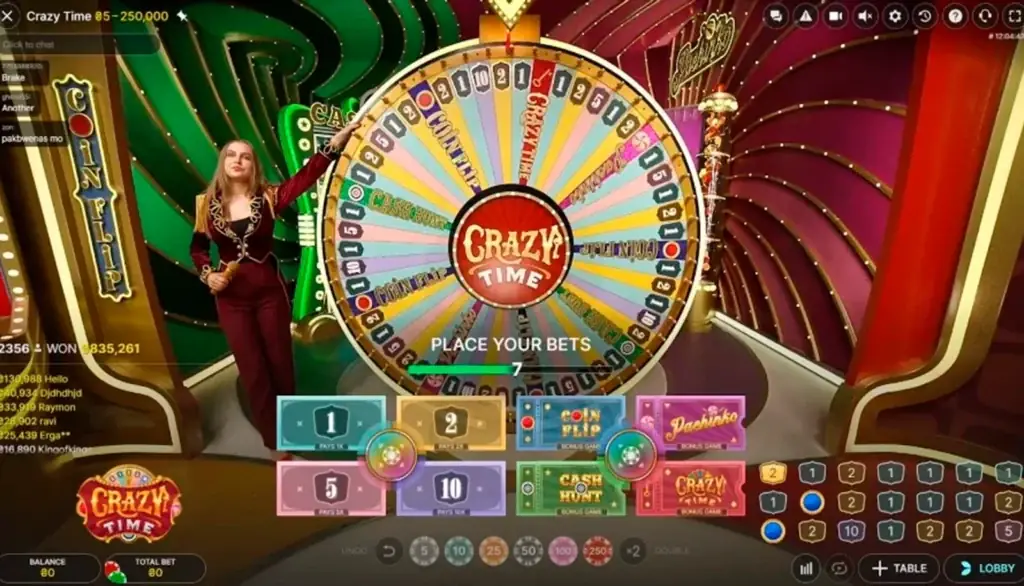
Crazy Time Strategy: An Honest Guide
This page covers Crazy Time strategy honestly. No winning system exists for Crazy Time. The game runs on a certified random number generator with a published 96.08% RTP, which means a built-in 3.92% house edge that no betting system, predictor, AI tool, or stat tracker can overcome. What this page does cover: bankroll management (the only meaningful framework), variance and risk profiles, the math behind common betting systems like 1-3-2-6 and Martingale (and why they fail), the gambler's fallacy applied to wheel outcomes, and the responsible gambling tools that genuinely help. If you came here looking for a winning strategy, the honest answer is that there isn't one. If you came here looking for ways to make your sessions more controlled and less harmful, this page can help.
Try the Free Crazy Time Demo: practise the format with no bankroll risk before you stake real money.
Play Crazy Time: operator checklist before real-money play. 18+. Play responsibly. BeGambleAware.
- Updated
- 25 May 2026
- Sections
- 15
- Focus
- No prediction claims

Section 01
The Honest Answer
There is no winning strategy for Crazy Time. The published Return to Player is 96.08%, which means a 3.92% house edge baked into the game's design. Across many spins, the math is fixed: for every £100 staked, the long-term expected return is £96.08, and the long-term expected loss is £3.92. No bet selection, betting system, AI predictor, stat tracker, "god strategy" pattern, or community-shared method changes those numbers.
This is the same situation that applies to roulette (where the house edge is built into the green zero), to slots (where the RTP is set in software), and to any casino game with a defined RTP. The house edge is a structural feature of the game, not an opponent to be outsmarted.
What does change between players is variance: how lumpy your wins and losses feel during shorter sessions. Some bet types deliver smaller wins more often (lower variance); others deliver rare bigger wins (higher variance). Variance is a real and meaningful dimension to think about, and the sections below cover it. But variance management isn't the same as winning. Over enough spins, the house edge wins. Knowing that up front is the foundation of an honest strategy conversation.
If you're playing Crazy Time, you're paying the operator a small percentage of your stake on average, in exchange for the entertainment value of the live broadcast and the chance of variance-driven bigger wins. That's the trade. Everything that follows on this page is about managing the trade sensibly and playing responsibly, not about beating it. Here's the thing: accepting the math up front is what makes sustainable play possible.

Section 02
Why No Predictor Works
People search for "crazy time predictor", "crazy time AI prediction", "crazy time prediction app", and similar phrases hoping to find tools that forecast the next wheel outcome. None of these tools work. This isn't an opinion; it's a function of how the game is built.
The Crazy Time wheel is RNG-controlled
Each spin of the Crazy Time wheel is determined by a certified random number generator (RNG), not by physics or by patterns. The motor that drives the wheel, the flapper position at the top, and the resulting landing wedge are all calibrated to produce a random outcome consistent with the published per-segment probabilities. The Top Slot reels are similarly RNG-driven.
This RNG is independently tested by four major audit labs: Gaming Laboratories International (GLI), eCOGRA, iTech Labs, and BMM Testlabs. Their job is to verify that the RNG produces statistically random outputs over very large sample sizes. If any of these labs detected an extractable pattern, certification would be pulled and Evolution Gaming would lose the licence to distribute Crazy Time. The audit chain is what makes the game legal to operate at UK-licensed casinos under the UK Gambling Commission.
Independent events, no extractable pattern
Each wheel spin is independent of every previous spin. The wheel doesn't "owe" a bonus after a streak of number outcomes. The wheel doesn't favour certain hours or certain days. The wheel doesn't react to player volume, bet sizes, or anything else outside its own RNG state.
This isn't a marketing claim; it's the mathematical definition of independent events. By definition, an independent event has no relationship to previous events. If outcome A occurred on the last spin, that fact provides zero information about the probability of outcome B on the next spin. The per-segment probabilities reset for every spin.
What predictors actually do
Most "Crazy Time predictor" tools that circulate online fall into one of three categories:
- Random output dressed up as prediction: the tool outputs a "prediction" that's actually random, then takes credit when it occasionally matches. This is the same logic as a horoscope: vague enough or random enough to occasionally seem right.
- Post-hoc pattern fitting: the tool shows a "pattern" extracted from recent outcomes and presents it as predictive. This is a misuse of statistics. Patterns in random data look meaningful but have no predictive value (any sequence of random outcomes contains apparent patterns).
- Direct misinformation: the tool claims AI or machine learning capabilities that don't exist. AI can't extract a pattern from a certified RNG output, by definition.
Evolution's own published FAQ explicitly states that the next bonus round can't be predicted. The wheel is designed to be unpredictable, and the certification framework verifies that it remains so.
Why this matters for your money
If a "predictor" appears to work for a session, it's because random outcomes occasionally cluster (variance). Over many sessions, predictor-based betting loses at the same rate as any other betting approach: roughly the house edge. The 3.92% expected loss per spin applies regardless of how you select your bets.

Data check
The RNG and Independent Events: The Math Foundation
Understanding why no system beats Crazy Time requires understanding two related concepts: how the RNG works and what "independent events" means in probability.
What "certified RNG" actually means
A certified random number generator produces outputs that, over very large sample sizes, match the published probability distribution to within statistical tolerance. For Crazy Time, that means:
- Across many spins, the "1" wedge lands roughly 21 of every 54 times (~39%)
- The "2" wedge lands roughly 13 of every 54 times (~24%)
- The Crazy Time bonus wedge lands roughly 1 of every 54 times (~1.85%)
- Other wedges land at their published rates
The "certified" part means that an independent audit lab has run the RNG output against statistical tests for randomness (frequency tests, runs tests, autocorrelation tests, etc.) and confirmed that the outputs pass those tests. Pass means no extractable pattern; fail would mean the RNG could be exploited.
What "independent events" means
Two events are independent if the outcome of one provides no information about the outcome of the other. Wheel spin number 500 and wheel spin number 501 are independent: if spin 500 landed on Pachinko, that fact tells you nothing about whether spin 501 will land on Pachinko, on a number, on Cash Hunt, or on anything else.
The probability of any specific outcome on spin 501 is still the same as the probability of that outcome on any other spin: ~39% for "1", ~24% for "2", ~13% for "5", ~7% for "10", ~7.4% for Coin Flip, ~3.7% for Cash Hunt, ~3.7% for Pachinko, ~1.85% for the Crazy Time bonus.
This holds even if the wheel just landed on the same outcome ten spins in a row. Each spin starts fresh. The wheel has no memory. The math is the math.
The gambler's fallacy
The gambler's fallacy is the mistaken belief that past random outcomes affect future random outcomes. Common examples:
- "The Crazy Time bonus hasn't hit in 100 spins, so it's due"
- "The '10' wedge landed three times in a row, so it's hot"
- "Pachinko hit twice in the last 20 spins, so it's cold now"
None of these statements is true in the way the gambler's fallacy implies. Past spins don't influence future spins. A wedge isn't "due" because it hasn't hit recently. A wedge isn't "hot" because it hit recently. The probability for the next spin is the same as for any other spin.
The reason this fallacy is so persistent is that human brains pattern-match by default. Random outcomes look patterned to us because we evolved to detect meaningful signals in noisy data. But the patterns we see in random outcomes are illusory; the outcomes themselves are statistically independent.

Section 04
Bankroll Management: The Only Meaningful Framework
If no system beats Crazy Time, what's left? Bankroll management. Bankroll management doesn't change your expected return (you still lose the house edge on average), but it does control how much you lose, over what time frame, and with what risk of running out of money mid-session. It's the difference between a sustainable approach to play and an unsustainable one.
What a bankroll is
Your bankroll is the total amount of money you've set aside for gambling, separately from money for rent, food, bills, savings, or any other purpose. The first rule of bankroll management is that your bankroll comes from disposable income only, not from credit, not from money you've borrowed, not from money earmarked for essential expenses. If losing your full bankroll would create financial stress, the bankroll is too large.
Setting a session bankroll
A session bankroll is the slice of your total bankroll you're willing to risk in one session. Reasonable session bankrolls are 5-20% of total bankroll. So if your total bankroll is £200, a session bankroll might be £20-40.
Once the session bankroll is gone (lost), the session ends. This is the discipline part of bankroll management: you don't reload from your total bankroll mid-session, and you definitely don't reload from money earmarked for other things.
Setting a session win cap
Many bankroll frameworks also include a session win cap: a level at which you walk away with winnings rather than continue. Reasonable win caps are 2-3× the session bankroll. So if your session bankroll is £30, you might set a win cap of £60-90 (total balance), meaning you walk away when you're up £30-60.
Win caps protect you from giving back winnings during variance. Without a win cap, the natural tendency is to keep playing, which over time means the house edge eats into the winnings until they're gone.
Unit sizing
Your unit size is the standard amount of one bet placement. Reasonable unit sizing is roughly 1-3% of your session bankroll per round. So with a £30 session bankroll, a unit size of £0.30-£1.00 per bet type works. With a £100 session bankroll, £1-3 per bet type works.
Unit sizing is the practical tool that determines how long your session lasts on average. Larger units mean shorter sessions and higher variance. Smaller units mean longer sessions and lower variance. Neither changes your expected long-term loss; both change your session experience.
Why bankroll management isn't a winning strategy
Worth being clear: bankroll management doesn't make you win. It manages how you lose: more slowly, with less catastrophic variance and volatility, with predictable session lengths, and with discipline preserved for when you walk away. Over many sessions, you still expect to lose the house edge on average. Bankroll management just keeps you from blowing up your finances along the way.
If you find yourself unable to stick to a session bankroll, unable to walk away at the win cap, or repeatedly reloading from money earmarked for other things, that's a meaningful warning sign. See the when-to-stop section and responsible gambling tools.

Read before acting
Risk Profiles and Variance
Variance is the dimension you can adjust. Different bet selections produce different variance profiles: how often you win, how big the wins are, and how lumpy your session-to-session results feel.
Conservative profile (lowest variance)
- Primary bets: "1" and "2" number bets only
- Why: these wedges cover 34 of 54 (~63%) of the wheel, so you hit a winning number on more than half of spins
- Expected feel: lots of small wins (1× and 2× stake), rare losses, no bonus round access
- Trade-off: payouts are small (1× to 2× stake), so wins barely offset losses over time; no exposure to the big bonus-driven outcomes
- Suits: players who want steady, frequent feedback and aren't interested in chasing big wins
Balanced profile (medium variance)
- Primary bets: mix of number bets (1, 2, 5) and 1-2 bonus bets (typically Coin Flip and one of Cash Hunt/Pachinko)
- Why: number bets provide frequent small wins; bonus bets provide occasional larger wins
- Expected feel: roughly half of spins hit something; occasional bonus rounds with bigger payouts
- Trade-off: higher stake total per round than conservative; still subject to the same long-term house edge
- Suits: players who want some variance but not extreme swings; the most common natural play pattern
High-variance profile (largest swings)
- Primary bets: bonus bets only (Cash Hunt, Coin Flip, Pachinko, Crazy Time), possibly skipping number bets entirely
- Why: bonus rounds carry the highest payout potential; missing the bonus means losing the round, but hitting one can deliver a large multiplier
- Expected feel: most spins lose; bonus rounds (when they trigger) can deliver 10×-1000× returns; rare extreme outcomes (like the verified 25,000× Cash Hunt from 11 December 2022) are theoretically possible
- Trade-off: long stretches without wins; bankroll depletes quickly during cold streaks; requires larger total bankroll to ride out variance
- Suits: players who want bonus-round exposure and accept long losing stretches as part of the experience
Important caveat
None of these profiles changes the house edge. All three return roughly 96.08% to the player over very large sample sizes. The conservative profile loses smaller amounts more steadily. The high-variance profile loses larger amounts in lumpier patterns (or occasionally wins big amounts in lumpier patterns). Over the long run, all three converge on the same expected loss rate.
The choice of profile is about how the experience feels, not about whether you win. A high-variance profile isn't a "better" strategy; it just produces lumpier outcomes that some players prefer.

Section 06
Bet Coverage Strategies
A common approach to Crazy Time is to spread bets across multiple options in the same round. This is called coverage. Here's how the math works.
What coverage achieves
Coverage reduces variance per round (you're more likely to win something on any given spin) without changing the long-term RTP. The total stake per round goes up because you're placing multiple bets, and the average return per round stays at 96.08% of that total stake.
A worked example
Say you bet £1 on each of 1, 2, 5, and Coin Flip (£4 total stake per round). Possible outcomes:
- Wheel lands on "1" (~39% of spins): you win £1 on the "1" bet, lose £3 on the other three. Net: -£2.
- Wheel lands on "2" (~24% of spins): you win £2 on the "2" bet, lose £3 on the other three. Net: -£1.
- Wheel lands on "5" (~13% of spins): you win £5 on the "5" bet, lose £3 on the other three. Net: +£2.
- Wheel lands on "10" (~7% of spins): you lose £4 (no bet on "10").
- Wheel lands on Coin Flip (~7% of spins): bonus round triggers; result depends on the bonus payout. Average Coin Flip RTP is 95.70%, so over time, average return on the Coin Flip stake is about £0.96 per £1, less the £3 lost on the other bets.
- Wheel lands on Cash Hunt, Pachinko, or Crazy Time bonus (~9% of spins): no bet on these; lose £4.
Across many rounds, this coverage pattern returns roughly 96.08% of the £4 staked per round, on average. That's the same 96.08% RTP that applies to any other bet pattern. Coverage doesn't beat the house edge; it just spreads the stake.
Coverage and Top Slot
The Top Slot multiplier can compound any winning bet, including bets in a coverage pattern. If the Top Slot lands on "5" with a 10× multiplier and the wheel lands on "5", a £1 bet on "5" pays £50 (5 × 10 × £1). This is where bigger wins come from across all profiles.
What coverage doesn't do
Coverage doesn't:
- Reduce the house edge
- Guarantee a win on every spin (number wedges only cover 45 of 54; bonus wedges only cover 9 of 54; some spins still lose money if your coverage doesn't include the winning wedge)
- Make any specific outcome more likely
Coverage is a variance management tool, not a winning strategy.

Data check
The 1-3-2-6 System: An Honest Math Look
The 1-3-2-6 betting system is a positive progression: you stake 1 unit on the first bet, 3 units on the second (if the first wins), 2 units on the third (if the second wins), and 6 units on the fourth (if the third wins). After any loss, you reset to 1 unit. After completing the full 1-3-2-6 sequence with four consecutive wins, you also reset.
The system is marketed as a way to "lock in profits" during winning streaks while limiting losses during losing streaks. Here's the math.
What the 1-3-2-6 system does
If you complete a full sequence (four wins in a row), you've staked 1+3+2+6 = 12 units across four bets, and you've won 12 units of profit (assuming even-money payouts). That's an attractive return relative to the small base stake.
If you win 1 then lose, you've net -£2 units (won 1, lost 3). If you win 1, win 3, then lose, you've net -£1 unit. If you win 1, win 3, win 2, then lose, you've net 0 (broke even). So the system has different recovery characteristics depending on where in the sequence the loss happens.
Why the 1-3-2-6 doesn't beat the house edge
The system's structural problem is the same as every positive progression: it relies on consecutive wins, and consecutive wins are random events with declining probability.
On a roughly even-money bet (like betting on "1" and getting a 1:1 payout when "1" lands), the probability of "1" landing is ~39% per spin. The probability of "1" landing four times in a row is roughly 0.39^4 = ~2.3%. So full sequences complete on about 2.3% of attempts. The other 97.7% of the time, you lose somewhere in the sequence.
The expected value calculation for the full sequence is:
- 2.3% chance of +12 units (full sequence wins)
- ~97.7% chance of various losses ranging from -1 to -3 units depending on where the sequence breaks
When you work through the math across all possible outcomes, the expected value per sequence attempt is approximately -3.9% of the average stake. That's the house edge showing up exactly where you'd expect it.
The 1-3-2-6 system doesn't change the underlying probability of any individual spin. It changes the distribution of your wins and losses (clumpier wins, somewhat more controlled losses), but it doesn't change the long-term expected loss rate. The 3.92% house edge on Crazy Time still applies, regardless of which betting sequence you're inside.
When the 1-3-2-6 feels like it's working
When the system "feels like it's working," it's because you've happened to hit a streak of winning sequences. This is normal short-term variance. Across many sessions, the average performance of 1-3-2-6 on Crazy Time matches the average performance of any other betting pattern: roughly -3.92% of average stake per round.
There's no positive-progression system that can convert a negative-expectation game into a positive-expectation one. This is a mathematical impossibility, not a function of system design quality.

Section 08
Other Betting Systems
The 1-3-2-6 isn't the only system marketed for Crazy Time or similar games. Here's an honest look at the others.
Martingale (negative progression)
Double your bet after every loss until you win, then reset to base. The marketing claim: a single win recovers all previous losses plus one base unit.
Why it fails: requires either an infinite bankroll or no betting limit (or both). UK casinos impose maximum bet limits per round (typically £100-£2,000 per bet type). A losing streak that pushes your required bet over the maximum means you can't double anymore; you've lost a substantial amount with no way to recover. The probability of a losing streak long enough to hit the maximum bet is small per session, but over many sessions, it becomes near-certain. When it happens, the loss wipes out months of small wins. Long-term expected value: still the house edge.
Fibonacci (negative progression)
Stake amounts follow the Fibonacci sequence (1, 1, 2, 3, 5, 8, 13, 21...). Increase after losses, decrease after wins.
Why it fails: same fundamental problem as Martingale (relies on bankroll depth and an eventual win to recover losses), just with a more conservative escalation rate. The Fibonacci sequence grows more slowly than doubling, so the bankroll required to ride out long losing streaks is somewhat smaller. But the expected value is still negative; the house edge still applies.
Paroli (positive progression)
Increase your bet after wins, reset after losses. Variant: 1-2-4-reset, or 1-3-2-6 as covered above.
Why it fails: doesn't change the underlying probabilities. Hitting consecutive wins is random; the probability of three consecutive wins on a ~39% bet is roughly 5.9%. The system has nice clumpiness properties (when it works, it works well; when it fails, the loss is just one base unit), but the long-term expected value is the house edge.
D'Alembert (negative progression)
Increase your bet by one unit after a loss, decrease by one unit after a win. Slower than Martingale.
Why it fails: requires a bankroll deep enough to ride out losing streaks. Doesn't change underlying probability. Long-term expected value is the house edge.
Labouchère (cancellation system)
Write down a sequence of numbers; bet the sum of the first and last; cancel after wins, extend after losses.
Why it fails: complex bookkeeping for the same fundamental result. Requires substantial bankroll for losing streaks. Long-term expected value is the house edge.
The underlying truth
No betting system based purely on stake sizing can convert a negative-expectation game into a positive-expectation game. This is a mathematical theorem, not an opinion. Any system that promises otherwise is either misunderstood by its promoter or actively misleading. The house edge is structural; bet sizing variations don't change it.

Game mechanic
Hot and Cold Segments: The Gambler's Fallacy
The "hot and cold segments" idea is that recent wheel outcomes can indicate which segments are more or less likely to land next. This is a textbook application of the gambler's fallacy, and it's mathematically wrong.
The fallacy explained
The fallacy comes in two flavours, both incorrect:
- "Hot" version: a segment that's landed recently is "due to land again" or "running hot". Bet on it because the streak will continue.
- "Cold" version: a segment that hasn't landed recently is "due to land" or "running cold". Bet on it because it's overdue for a hit.
Both versions assume that past random outcomes influence future random outcomes. They don't. As covered in the RNG and independent events section, each wheel spin is independent. The probability of any segment landing on the next spin is the same as the probability of that segment landing on any other spin, regardless of what happened on the previous spins.
If the Crazy Time bonus wedge hasn't landed in 200 spins, the probability of it landing on the next spin is still ~1.85%. If it just landed twice in a row, the probability of it landing on the next spin is still ~1.85%. The wheel has no memory; the previous spins don't change the next spin's probability.
Why the fallacy persists
Humans are wired to detect patterns. We evolved in environments where pattern detection helped us survive (predator tracks, weather patterns, seasonal changes). Random data triggers the same pattern-detection circuitry, which is why random outcomes look meaningful to us.
A streak of three "10" wedges in a row looks like a hot pattern. It isn't; it's just a normal product of randomness. With 54 possible outcomes per spin and many spins per session, every kind of streak shows up eventually. Streaks aren't signals; they're noise that happens to be visually clumpy.
Stat trackers and the prediction myth
Stat tracker sites (the ones that display recent wheel outcomes, hit frequencies, and patterns) are entertaining and can be useful for verifying long-term published probabilities. They're not predictive. A tracker can tell you what's happened; it can't tell you what will happen next, because that's a function of the RNG, not of recent history.
Some players use trackers to inform bet selection ("the Coin Flip hasn't hit in a while, I'll bet it"). This is the gambler's fallacy in action. Trackers don't unlock predictive insight; they just visualise random history. Anyone selling a tracker as a "prediction tool" is misrepresenting what the tool does.
For tracker viewing (verifying published probabilities, looking at historical hit frequencies for entertainment), see Crazy Time live statistics and historical wheel data when the page is live. For prediction, no tracker works.
Sample size and probability convergence
One legitimate use of stat trackers: confirming that published probabilities hold over large samples. If you watch 10,000 spins, you'd expect the "1" wedge to land roughly 3,900 times (~39%), the Crazy Time bonus to land roughly 185 times (~1.85%), and so on. Small deviations are normal; large deviations across very large samples would indicate a problem with the RNG (which is why the audit labs do exactly this kind of testing).
But the convergence to published probabilities happens across many thousands of spins, not within a session. A 100-spin sample can deviate substantially from published probabilities just by chance. This is why trackers showing "the '1' wedge is overrepresented this hour" isn't useful information; the sample is too small to be meaningful.

Data check
Session and Stake Sizing: Practical Math
Bankroll management requires concrete numbers. Here's a practical framework.
How long a session "should" last
This is a personal question, but the math can help you set realistic expectations. The relationship between bankroll, stake size, and session length is rough but useful.
A rule of thumb: with a 3.92% house edge and even bet sizing, your bankroll erodes by roughly 3.92% of total stake per round on average. So if you stake £5 per round and play 20 rounds per hour, your average loss is about £4 per hour (5 × 20 × 0.0392). Your bankroll will last roughly: bankroll size / average hourly loss.
Examples:
- £50 bankroll, £1 per round, 20 rounds/hour: ~£0.78 average loss per hour, bankroll lasts ~64 hours on average (but with substantial variance; could be much shorter in a single session)
- £100 bankroll, £5 per round, 20 rounds/hour: ~£3.92 average loss per hour, bankroll lasts ~25 hours on average
- £100 bankroll, £20 per round, 20 rounds/hour: ~£15.68 average loss per hour, bankroll lasts ~6 hours on average
These are averages. Actual session length varies because of variance. A bad session can blow through your bankroll in 30 minutes; a lucky session can stretch it. The expected length is just the long-term average.
Setting unit size to match goals
If your goal is a longer session, smaller units per round extend the session length. If your goal is a shot at meaningful wins, larger units make those wins (when they happen) more meaningful, but accept faster bankroll depletion.
A common framework: pick a session length you want (say, 1 hour), divide your session bankroll by the expected hourly loss rate, and adjust unit size to match. If you have a £30 session bankroll and want a 1-hour session, target ~£3 average hourly loss → ~£0.75 per round at 20 rounds/hour → unit size of about £0.10-£0.20 across coverage bets.
Variance buffer
The above math assumes "average" performance. Actual sessions vary because of variance. To buffer against bad-luck sessions:
- Add 30-50% to your nominal bankroll requirement
- Set a hard session stop-loss (50-70% of session bankroll); when hit, the session ends regardless of how much time has passed
- Don't reload mid-session
A session bankroll that gets depleted before your target session length means you had a bad-luck session. That's the math doing its job. The discipline is in not chasing that loss with additional money.
What "session" means
Important: a "session" doesn't have to be one continuous play period. If you take a break and come back later the same day, that's still part of the same session for bankroll management purposes. The point of session limits is to control money risk over a defined time period, not to make sure you sit at the same screen continuously.
If you find yourself opening a fresh session immediately after losing a session, that's a warning sign worth paying attention to. See the when-to-stop section and what actually helps.

Section 11
When to Stop
The walk-away trigger is the most important practical skill in bankroll management. Without walk-away discipline, even good bankroll planning gets undone.
Pre-set triggers (recommended)
Decide before you start playing:
- Session loss limit: when you've lost £X (or X% of your session bankroll), session ends. Recommended: 50-70% of session bankroll.
- Session win cap: when you've won £Y (or your balance reaches Y× session bankroll), session ends. Recommended: 2-3× session bankroll.
- Session time limit: when you've been playing for Z minutes/hours, session ends regardless of where you are financially. Recommended: 60-90 minutes maximum.
Pre-set triggers work because they remove in-session decision-making (which gets compromised when you're emotionally invested in recovering a loss or extending a win).
In-session warning signs
If you notice any of these, stop the session immediately:
- You're betting more per round than you planned because you "need to recover"
- You're playing past your time limit because you "want to win this back"
- You're thinking about depositing more money than you'd planned
- You're feeling angry, anxious, or desperate while playing
- You're checking the wheel hoping a specific outcome will save the session
- You've already lost your planned session bankroll and you're still playing
- You're playing while tired, drunk, or emotionally upset
These are warning signs of chasing losses, which is a strong predictor of escalating gambling harm. The honest, evidence-based response is to stop the session, log out, and step away.
Walk-away strategies
When the trigger fires:
- Close the browser or app immediately. Don't think about it; just close.
- Step away from the screen for at least 15 minutes. Walk around, get water, do something unrelated.
- Do not log back in for at least 4 hours, ideally not until the next day.
- Use operator session reminders or reality checks to surface walk-away timing during play.
- Use operator cooling-off (24 hours to 6 weeks) if a session ended badly.
- Use GAMSTOP (UK-wide self-exclusion, 6 months to 5 years) if you're losing control across multiple operators.
The walk-away itself is the win. Discipline preserved equals bankroll preserved for future sessions, equals long-term sustainable play.
When walking away alone isn't enough
If you find yourself unable to stick to walk-away triggers, repeatedly chasing losses, or experiencing financial or emotional harm from your play, that's a meaningful signal. Free, confidential support is available:
- BeGambleAware: 0808 8020 133 (free helpline, 24/7) or begambleaware.org
- GamCare: gamcare.org.uk
- GAMSTOP: gamstop.co.uk (UK-wide self-exclusion)
These services exist specifically for the situations where personal discipline isn't enough. Using them is the responsible choice, not a sign of failure.
Responsible gambling tools and UK support resources covers the full framework in detail.

Section 12
Tactics That Don't Work
A quick roundup of approaches commonly marketed for Crazy Time that don't deliver what they claim.
- AI predictors: don't predict RNG outputs. Random output, post-hoc patterns, or pure misrepresentation.
- "Hot" and "cold" segment tracking: gambler's fallacy. Past spins don't influence future spins.
- Martingale, Fibonacci, 1-3-2-6, and other progressions: don't change house edge. Manage variance distribution, nothing more.
- "Best time to play": no time-of-day pattern exists. 24/7 RNG with no time-based behaviour.
- "Lucky" presenters: presenters don't influence outcomes. RNG determines results, not the human spinning the wheel.
- Following community pick groups: same betting recommendations applied to the same RNG-driven game produce the same long-term -3.92% expected return.
- Crazy Time strategy calculators: no calculator can compute an edge against a certified RNG. Output is theatre.
- "Crazy Time god strategy": marketing language for nothing real. There's no special method that beats the math.
- Betting only on bonuses to "guarantee a big win": bonus bets cover 9 of 54 wedges (~17%); most spins lose. High variance, same long-term RTP.
- Buying access to "professional" betting groups or systems: paying to access information that doesn't exist. The information being sold isn't predictive because the underlying game can't be predicted.
If you encounter any of these being marketed (especially with claims of promised wins or AI-powered prediction), treat them as marketing of inert or harmful products, not as legitimate strategy resources.

Section 13
What Actually Helps
If no betting system or prediction tool works, what actually makes Crazy Time play sustainable? The answer is genuinely simple: responsible gambling tools and personal discipline.
The UK-licensed operator RG toolkit
Every UK-licensed operator is required to provide a stack of responsible gambling tools. Use them.
- Deposit limits: set a cap on how much you can deposit per day, week, or month. Lower can be set immediately; higher requires a 24-hour cooling-off period. This single tool prevents most escalation patterns.
- Loss limits: cap how much you can lose over a defined period. Stops the "one more deposit" pattern in its tracks.
- Wagering limits: cap total staked per session. Useful for capping session intensity.
- Reality checks: pop-up reminders showing elapsed time and net result. Set to 30 or 60 minutes. Worth using on any session over an hour.
- Time-out (cooling-off): 24 hours to 6 weeks, your choice. Account is locked for gambling but you can log in to withdraw funds. Useful after a bad session.
- Self-exclusion (operator-level): 6 months minimum, longer available. Account is locked for gambling at that specific operator for the full period.
These tools work because they remove in-session decision-making during emotional moments. Pre-committed limits don't get talked out of.
GAMSTOP: the UK-wide self-exclusion
GAMSTOP is a free service that self-excludes you from every UK-licensed gambling operator at once, for 6 months, 1 year, or 5 years. Registration is at gamstop.co.uk. Once you register, every UK-licensed operator must block your account during the exclusion period. The exclusion can't be undone within the chosen period.
GAMSTOP is the strongest single intervention available for someone losing control of gambling. It removes the option to play across the entire UK-regulated market, which is far harder to circumvent than personal discipline alone.
Free support services
If gambling is affecting your finances, relationships, work, or mental health, free confidential support is available:
- BeGambleAware (0808 8020 133, free 24/7 helpline) or begambleaware.org: helpline, live chat, self-assessment tools, treatment information.
- GamCare (gamcare.org.uk): UK charity providing free counselling and treatment.
- Gambling Therapy (gamblingtherapy.org): free global online support.
- Citizens Advice (citizensadvice.org.uk): debt and financial advice, including gambling-related debt.
- Samaritans (116 123, samaritans.org): free, confidential support for emotional distress.
Using these services isn't a failure. It's the same as seeing a GP about a physical health concern: a sensible response to a real issue.
Practical mindset shifts
A few mindset reframes that genuinely help over time:
- Treat gambling as entertainment, not investment. The expected return is negative; you're paying for the entertainment value of variance.
- Treat bankroll as expense, not principal. The money you put in the bankroll is gone in expectation; any return is variance bonus.
- Walk-away discipline is the win. Sessions that end on triggers, regardless of result, are sustainable sessions.
- Avoid playing while emotionally compromised. Tired, drunk, anxious, or angry are not states for variance-based gambling.
- Don't chase losses. Chasing escalates harm. If a session lost, the session lost; the next session starts fresh with the same expected return.
These aren't profound insights, but they're the actual ingredients of long-term sustainable play. Combined with the operator-level RG tools and GAMSTOP if needed, they're the real "strategy" for Crazy Time.

Quick answers
Frequently Asked Questions
Short answers are opened with native details controls, so the page stays crawlable and keyboard-friendly without extra JavaScript.
Is there a winning strategy for Crazy Time?
No. Crazy Time has a published 96.08% RTP and a 3.92% house edge built into the game's design. No betting system, predictor, AI tool, or pattern analysis can convert this negative expected value into a positive expected value. Across many spins, the math is fixed. Bankroll management can control how you lose, but it can't make you win.
Do Crazy Time predictors actually work?
No. The Crazy Time wheel runs on a certified random number generator audited by Gaming Laboratories International, eCOGRA, iTech Labs, and BMM Testlabs. Each spin is independent of every previous spin. No tool can extract a pattern from certified RNG output because there is no pattern to extract. Predictors that appear to work are either generating random output that occasionally matches, fitting post-hoc patterns that aren't predictive, or directly misrepresenting their capabilities.
What about AI prediction for Crazy Time?
AI can't predict RNG outputs. By the mathematical definition of randomness, certified RNG outputs contain no extractable pattern, which means no learning algorithm (whether classical machine learning or modern AI) can learn predictive features from them. Any "AI Crazy Time predictor" being sold is misrepresenting what AI can do with random data.
Does the 1-3-2-6 system work for Crazy Time?
No, in the sense that it doesn't beat the house edge. The 1-3-2-6 is a positive progression system that changes the distribution of wins and losses but not the long-term expected value. Across many sequence attempts, the system loses at approximately the same rate as any other bet selection: roughly -3.92% of average stake. The system has some appealing clumpiness properties (wins feel concentrated; losses cap at smaller amounts in some sequences) but doesn't change the underlying math.
What about Martingale on Crazy Time?
Martingale requires doubling your bet after every loss until you win. The problems are that UK casinos impose maximum bet limits (typically £100-£2,000 per bet type), and your bankroll has a finite size. A losing streak that exhausts either your bankroll or hits the maximum bet means you lose a substantial amount with no recovery path. The probability of such streaks isn't zero, and over many sessions, the cumulative expected value is still the house edge.
Are stat trackers useful?
Stat trackers are useful for verifying that published probabilities hold over large samples (a legitimate audit-style check). They're useful for entertainment if you enjoy watching wheel history visualisations. They're not useful for prediction because the underlying RNG has no extractable pattern. Any tracker being marketed as predictive is misrepresenting what the tool does.
What's the safest bet on Crazy Time?
The lowest-variance bet is the "1" wedge: 21 of 54 wedges (~39% hit rate) paying 1× stake. This bet hits frequently but pays small amounts; losses accumulate slowly but steadily. The expected long-term return on "1" bets is still 96.08% of stake, the same as any other Crazy Time bet pattern. "Safest" means lowest variance, not best return.
Can I make Crazy Time profitable through bankroll management alone?
No. Bankroll management doesn't change your expected return; it changes how you experience variance and how much risk you take. Even with perfect bankroll discipline, the long-term expected outcome is loss at the house-edge rate (3.92% of total staked, on average). Bankroll management makes the loss sustainable and prevents catastrophic blow-up; it doesn't generate profit.
How do I set a sensible session bankroll?
Use disposable income only (not money for rent, bills, savings, or essentials). A reasonable session bankroll is 5-20% of your total gambling bankroll. Set a session loss limit (typically 50-70% of session bankroll) and a session win cap (typically 2-3× session bankroll). When either trigger fires, the session ends. Don't reload mid-session.
What should I do if I think I have a gambling problem?
Contact BeGambleAware (0808 8020 133, free 24/7 helpline) or GamCare (gamcare.org.uk). Both offer confidential, free support. Use GAMSTOP at gamstop.co.uk to self-exclude from every UK-licensed gambling site at once (6 months, 1 year, or 5 years). Talk to your GP about gambling-related stress or anxiety. If gambling is affecting your finances, contact Citizens Advice (citizensadvice.org.uk) for debt support. These services are free, confidential, and exist specifically for these situations. Using them is the responsible choice, not a failure.